
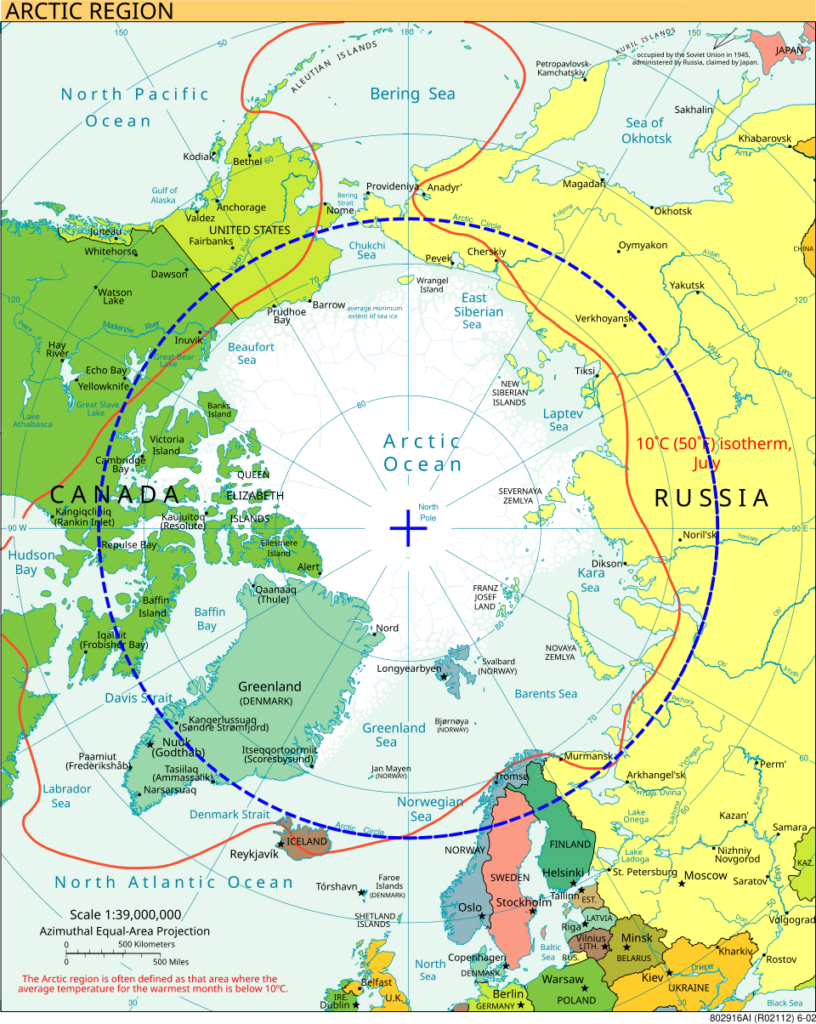
As the Arctic Ocean widens and the ice melts, the potential for future technologies becomes greater and greater. At the center of U.S. defense strategy is the partnership with Canada which ensures early-warning systems can be placed along the northern routes to identify targets and intruders before they enter critical air space. Particularly as new technologies – like hyper sonic missiles and low-flying cruise missiles – emerge, the need for NORAD to integrate closely with Canadian systems and to update those already existing has been a significant point of contention. In Washington, there is perpetual worry over what Beijing and Moscow are planning in the region, and as China increases its own Arctic capabilities, the question of the future will be whether or not the United States and Canada can work closely enough to deter threats from destroying one or both. Any attack on the United States from the Arctic must pass through Canada, so it should be in Canada’s best interest to invest wholeheartedly in the systems, but recent political troubles have left politicians more focused on internal developments than collective security.
With America pursuing such an isolationist strategy, it’s becoming increasingly evident that some strategic partnerships – such as those with Canada – are incredibly important to maintain operational security and to ensure safe borders from potential attackers. As far as power projection goes, the U.S. is going to have to accept that Canada is an ally and that they should retain some level of control over systems planted on their land. At the same time, Canada should be reasonable enough to understand that in any war with Russia or China, Canada is standing between the two and will undoubtedly face the same scrutiny of destruction.
China and Russia will be watching with eagle eyes to see how well the U.S. and Canada can work together. If the partnership falls apart and Canada refuses to house NORAD, then such a sign of weakness will only embolden the two towards more operations in the Arctic. On the other hand, however, if American warning systems can be installed in the Canadian hinterlands, then the U.S. again retains a status quo control over the northern passages. As more and more shipping goes up north, too, the ability for American hard power to be projected across the Arctic may come in handy when embargoing or in future trade wars with China or Russia.
The current negotiations between NORAD and Canada are representative of a deal of international arbitration between two states which requires no other involvement. It’s a case, thus, of cooperation towards a common goal which is indicative of how the world should generally function without IGOs. Though, when countries choose to arm themselves against others, grand organisations like the UN ultimately lose power to arbitrate and, when countries are unwilling to commune with one another, more war begins. What would perhaps be more liberal would be an armistice between China, Russia, Canada, and the U.S. to guarantee safe passage in the Arctic and to de-arm missile sites, though, in today’s world, such a dream is rare to come to light.
Article: https://www.nytimes.com/2026/03/23/world/americas/canada-us-arctic-military-norad.html
This is a pretty cool article.
Very interesting, what an article!