
By Iain Marlow
September 17, 2019, 8:00 PM EDT Updated on September 18, 2019, 5:30 AM EDT
Hong Kong’s government doesn’t see any benefit in conceding to more demands from protesters and the increasingly violent demonstrations are unlikely to stop anytime soon, according to a top adviser to leader Carrie Lam.
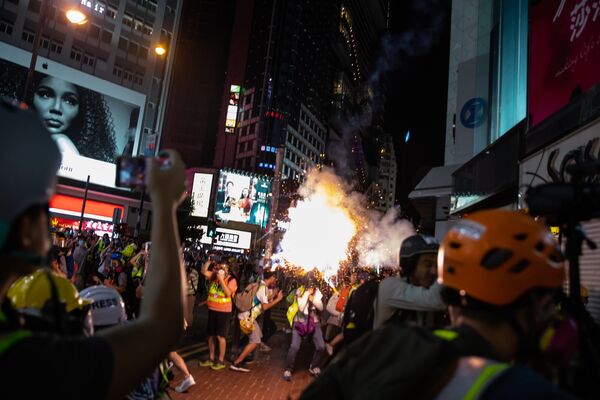
Radical demonstrators — some of whom have lobbed petrol bombs at police and vandalized subway stations in recent weeks — won’t give up their struggle even if the government meets all of their demands, said Bernard Chan, convener of the city’s Executive Council. While more moderate protesters may be swayed by moves to address social inequality, their die-hard peers are unlikely to give up, he said.
“No one is foolish enough to think that the more violent, more radicalized ones will dissipate anytime soon — I’m afraid that this might drag on for a while,” Chan said in an interview this week. “They give the impression that it’s the five demands they want, and they’ll walk. Come on, we all know that’s not true. The five demands may be just the outset. The underlying issues are about all the other social issues we’re facing in Hong Kong.”
Chan spoke after another weekend of protests descended into violence, less than two weeks since Lam’s government made its most significant concession to date by announcing it would formally withdraw a controversial bill that kicked off the movement. While that met one of the five demands called for by protesters, it did little to quell the unrest.
Timeline: Hong Kong’s 100 Days of Protests
The city has been gripped by historic pro-democracy rallies that have stretched into a fourth month. What began as pushback against legislation allowing extraditions to China has shifted into calls for greater democratic freedoms.
Hong Kong authorities said Wednesday that they would cancel a National Day fireworks display scheduled for Oct. 1, the politically-sensitive 70th anniversary of Communist Party rule in China, citing safety concerns. Large crowds are expected to protest in the city on that day, and key organizer the Civil Human Rights Front has said it will apply for a permit to march.
U.S. lawmakers are considering passing legislation that would sanction Chinese officials responsible for abducting or extraditing anyone from Hong Kong to the mainland. It would also seek to safeguard the autonomy that underpins special trading privileges for Hong Kong, which are crucial to its economy.
U.S. Lawmakers Seek to Ramp Up Pressure on Hong Kong
In addition to the withdrawal of the extradition bill, Hong Kong’s demonstrators have also called for an independent inquiry into the violence, an amnesty for those charged during the unrest, rescinding the categorization of participants as “rioters” and the implementation of full universal suffrage. Tens of thousands marched in the city center over the weekend, some chanting “Five Demands, Not One Less.”
‘No Go’
Chan said amnesty for people charged with crimes was a “no go” as it violated Hong Kong’s rule of law. Launching a formal inquiry would take too long, possibly years, and wouldn’t do anything to solve the immediate crisis, he added.
“It sounds good, it might be a good diversion, but it’s not solving the problem,” Chan said.
Here’s How Hong Kong’s Unrest Is Hitting the Economy: Tracker
Lam’s government is intent on addressing the social inequality they believe is the root cause of the protests, Chan said, despite many protesters insisting their real grievance is Hong Kong’s lack of true democracy. One survey led by the Chinese University of Hong Kong suggested that calls for an independent inquiry also ranked near the top of the protesters’ motivations.
He said he hoped Lam’s efforts to engage in dialogue with residents will help end demonstrations, but added that the movement’s leaderless nature has complicated that process. In a briefing this week, Lam said she will meet with local district councilors on Wednesday evening and begin meetings with citizens next week as part of a formal dialogue process.
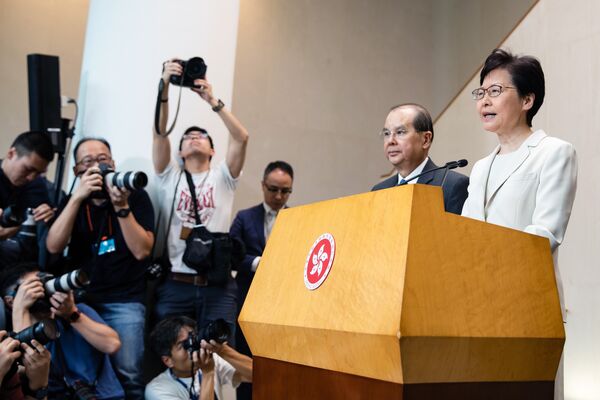
However, Chan said many people didn’t want to be seen meeting Lam, whose popularity has plunged as unrest worsens.
“Some people have accused her of hiding. It’s not true. She’s been seeing people every day since June, but funnily enough, many would prefer not to be seen meeting her,” he said. “I guess they’re afraid people might question, ‘Why you? Why are you seeing her? Are you representing us?’”
U.S.-China talks are back on, one of the world’s top investors sounds the alarm and Amnesty International accuses Hong Kong police of “torture.” Here are some of the things people in markets are talking about today.
Back at the Table
China and the U.S. are talking trade again. Negotiators have resumed face-to-face discussions in Washington, while the Trump administration says a Chinese delegation will visit American farmlands next week. The talks are expected to lay the ground-work for top-level negotiations between U.S. Trade Representative Robert Lighthizer, Treasury Secretary Steven Mnuchin and Vice Premier Liu He in October. The past two months have seen a ratcheting up of the trade war, after the last set of talks in late July. Since then, China’s trade performance is showing signs of a bad situation becoming worse, U.S. growth has decelerated and the OECD has forecast the slowest global expansion in a decade.
‘Excessive Force’
Hong Kong police beat pro-democracy protesters in custody and committed acts that amount to “torture,” Amnesty International alleged in a new report. Police used “unnecessary and excessive force” in making arrests, beat a protester for declining to answer a question and threatened to electrocute a man’s genitals after he refused to unlock his phone, the human rights group said. The Hong Kong Police said it would not comment on individual cases and that police officers would give warning of their intention to use force when circumstances allowed. Officers are required to use a “high level of restraint at all times,” it said. As the protests have rolled on, one humble accessory has emerged as a demonstrator’s most valuable, and versatile, tool.
Market Open
Asia stocks looked set for muted gains after U.S. equities ended the day near where they started. The dollar sank and Treasuries rose amid a slew of fresh monetary-policy decisions. After getting a boost from positive comments on trade by White House economic adviser Larry Kudlow early in the day, equities took a leg down after a report about a U.S. official threatening steeper tariffs against China. In China, all eyes will be on the Loan Prime Rate — a new gauge of borrowing costs. In India, central bank chief Shaktikanta Das said there’s room for interest-rate cuts.
Two Japans
Japan has a population problem, and it’s a cautionary tale for wealthy countries around the globe. The Japanese economy is essentially split in two. Cutting-edge businesses and world-class wealth fill the urban-industrial corridor stretching about 300 miles from Tokyo through Osaka; just about everywhere else, small cities and towns are dying as people relocate in search of opportunity. The rural population is expected to plunge another 17% by 2030 — an extreme example of a trend hitting countries from the U.S. to Italy. The big question is how policy makers respond to a trend that, so far, seems impossible to reverse.
Here’s Looking at You
India is planning to set up one of the world’s largest facial recognition systems. Prime Minister Narendra Modi’s government will open bids next month to build a system to centralize facial recognition data captured through surveillance cameras across India. It would link up with databases containing records for everything from passports to fingerprints to help India’s depleted police force identify criminals, missing persons and dead bodies. The plan promises to be a lucrative opportunity for surveillance companies. But in a nation with no data privacy laws and a government that just shut down the internet for the last seven weeks in the key state of Kashmir to prevent unrest, it’s also ringing alarm bells.
Terms of ServiceTrademarksPrivacy Policy ©2019 Bloomberg L.P. All Rights ReservedCareersMade in NYCAdvertiseAd ChoicesContact UsHelp