
Article: Reuters
Historical Context Source: Council of Foreign Relations
Pakistan has reached a deal worth more than $4 billion to supply weapons and military equipment to Libya’s eastern-based Libyan National Army (LNA), according to Pakistani officials. The agreement was discussed during a visit by Pakistan’s army chief to Benghazi, where he met senior LNA figures. The deal reportedly includes fighter jets, training aircraft, and other land, sea, and air systems, with deliveries spread over several years. Libya has been under a UN arms embargo since 2011, imposed after the NATO-backed uprising that toppled Muammar Gaddafi and split the country between rival authorities. Pakistani officials said the agreement does not breach UN sanctions, though it is likely to face international scrutiny due to Libya’s ongoing political fragmentation and instability.
Historically, following the 2011 NATO-backed uprising, two major players emerged among the various rival authorities. In Eastern Libya, the LNA, and in Western Libya, the Government of National Unity (GNU). In 2020, tensions reached a boiling point, and the LNA launched a full-scale invasion, attempting to seize power by taking the GNU’s capital. Furthermore, it was supported partially by Russia, the UAE, and Egypt. Yet it failed, leading to a ceasefire, mainly because of Turkey’s support for the GNU, therefore it retained power. In the following year, 2021, the UN recognized only one limited government in Libya, the GNU. Despite lacking recognition, the LNA still controls the majority of Libya. This begs the question: why isn’t Libya split?
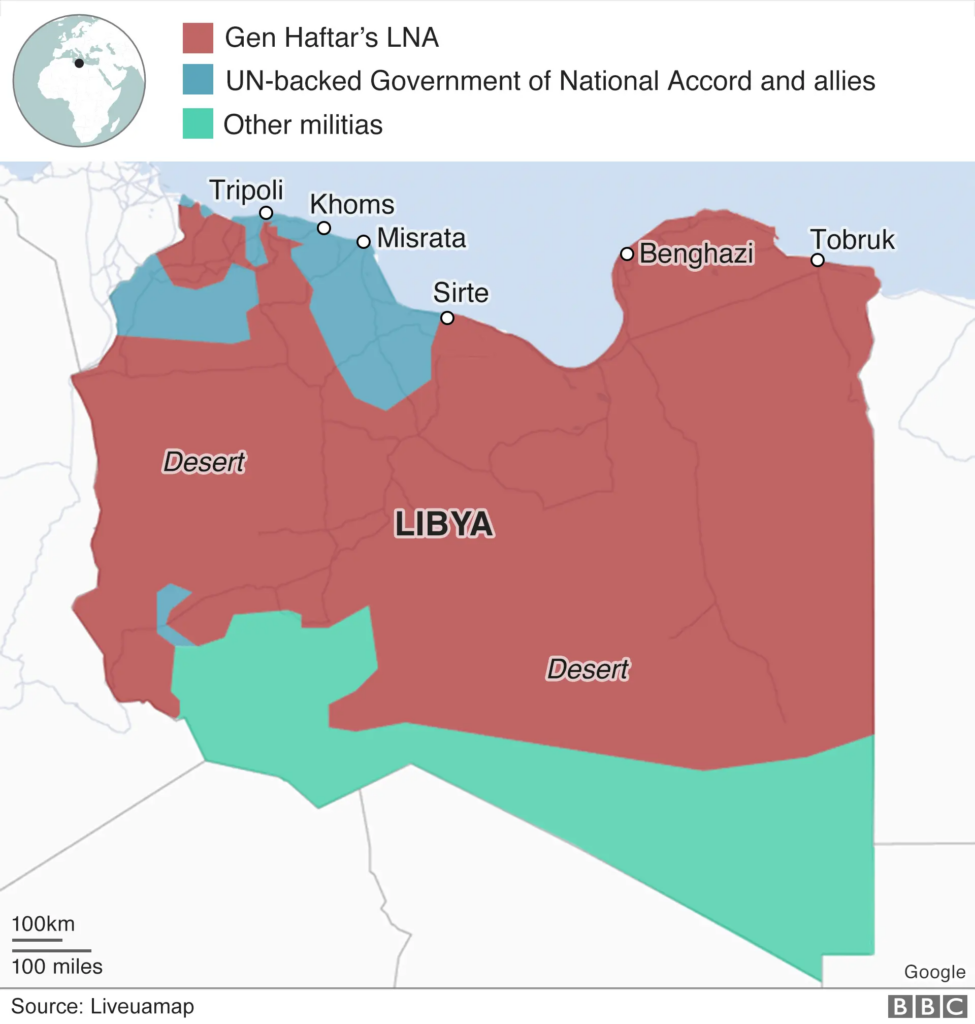
A formal split risks Libya’s oil revenue. Both sides would rather be a unified, dysfunctional state than isolated, economically shattered states. The conflict is a power struggle between elites, and the ambiguity provides ammunition to blame the other side. Where the Pakistani deal raises eyebrows is their providing weapons to a non-UN-recognized actor, potentially igniting a future conflict.
Pakistan will use the money generated to continue developing its weapons with China. Additionally, Libya has the largest known oil reserves in Africa, and the weapons deal may mark the start of an economic agreement for the LNA’s oil. China will continue to cooperate with Pakistan because of its strategic positioning next to its long-term asian rival, India. The GNU will raise its concerns with the UN and highlight the possible undermining of the 2020 ceasefire agreement. The LNA will continue its weapons buildup, and if the GNU loses support, the LNA may pounce on the opportunity to invade.
In class, we learned about shatterbelts. Libya qualifies as a shatterbelt because it is made up of multiple unstable, dictatorial governments, which have exacerbated social issues in the lives of Libyans. Additionally they are vulnerable to outside influence; for instance if Turkey had not intervened in favor of the GNU, the GNU government would have collapsed. We also learned about realist theory, which holds that states are rational actors and will do what is necessary to maintain their survival. The split of Libya into two separate state, would put both states’ survival in jeopardy