
Article: AP News
Afghanistan is facing a deepening humanitarian crisis as major international aid cuts have sharply reduced food assistance. More than 17 million people face crisis-level hunger, while nearly 23 million depend on aid. Funding reductions to the World Food Programme have forced it to limit support to the most vulnerable. Economic collapse, drought, earthquakes, refugee returns, and Taliban restrictions on women’s employment have compounded the crisis, with the U.N. warning conditions will worsen without renewed funding.
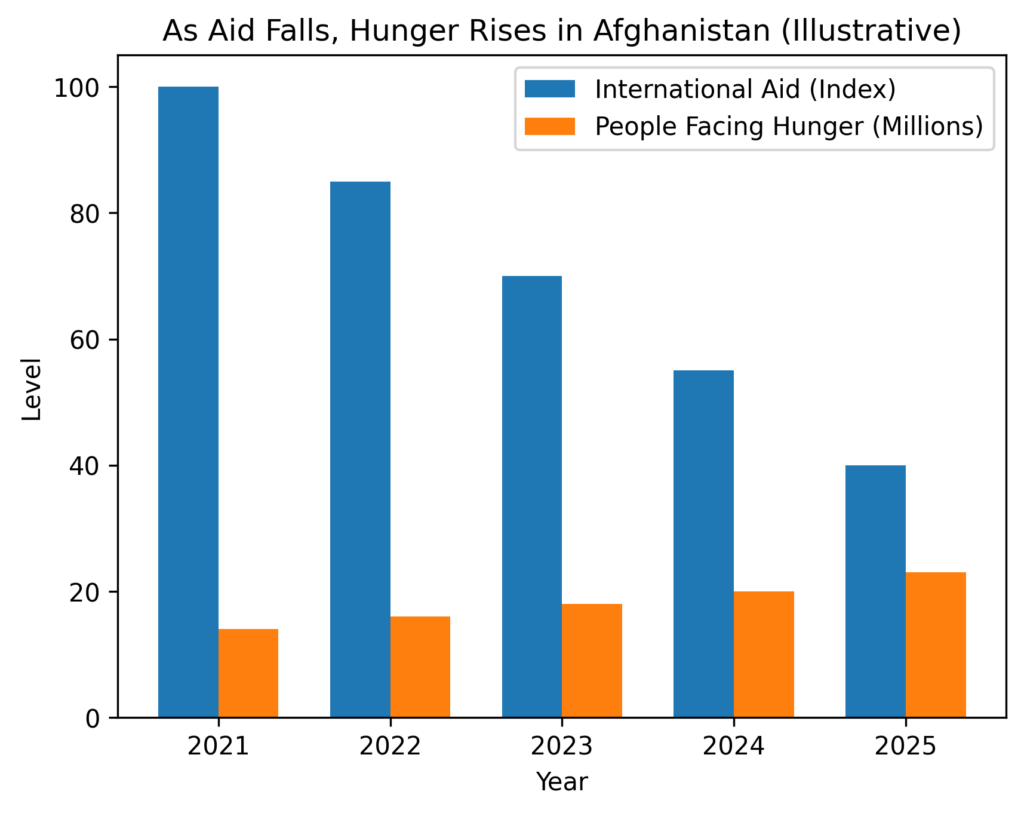
The Afghanistan hunger crisis is dire. Afghans have no functional markets, jobs, or banking systems. Furthermore, two recent deadly earthquakes struck, damaging the little infrastructure available. The solution for many was to flee, yet Afghan refugees from countries such as Iran and Pakistan have refused their entry. This puts the Taliban in a very volatile political environment during a cold winter.
To solve the crisis, the government will need to make a deal with an external actor, most likely the West. Another solution would be to receive significant aid, which is unlikely given the shift in Western ideology from Liberal Hegemony to offshore balancing. While the people may find the Taliban illegitimate if more than half the population is starving, you must consider that Afghanistan is an Islamic state. Their legitimacy derives from ideology and its enforcement. If the Taliban were to give up anything to external actors, especially the West, it would reframe their victory as conditional rather than absolute, which would erode the myth of total sovereignty. Therefore, there are no solutions in sight. The Taliban government will likely frame this as spiritual to shift blame away from the government’s failures and pressure for reform.
From a stakeholder perspective, reactions will diverge sharply. The U.S may continue to push for the renewed control of Afghanistan’s Bagram airbase by the United States. International aid may increase if the President reaches a deal with the Taliban controlled government, most likely in exchange for the base. Alternatives also include easing sanctions and allowing for the unfreezing of assets without recognizing the Taliban government. The problem with this possibility is that the Taliban’s legitimacy is based on faith. This would be ideologically inconsistent. Therefore, expect that Afghanistan may receive aid, but the population will most likely die off until it reaches an optimal level.
In class, we learned about American grand strategies. Liberal Hegemony is the belief that a state should use its powers to spread liberal values and democracy. For Afghanistan, this came in the form of U.S and Western aid. Following the election of President Trump, the strategy has shifted toward offshore balancing: it redirects attention to regions outside its own borders and intervenes only when justified. Therefore, aid continues to decline for Afghanistan because it isn’t the U.S or its Western allies’ problem. We also learned about Geopolitical Hierarchy. The U.S is a global power extending its reach. Despite Afghanistan not aligning itself with international and regional powers, it depends on them. Therefore, Afghanistan is a client/bandwagon State.